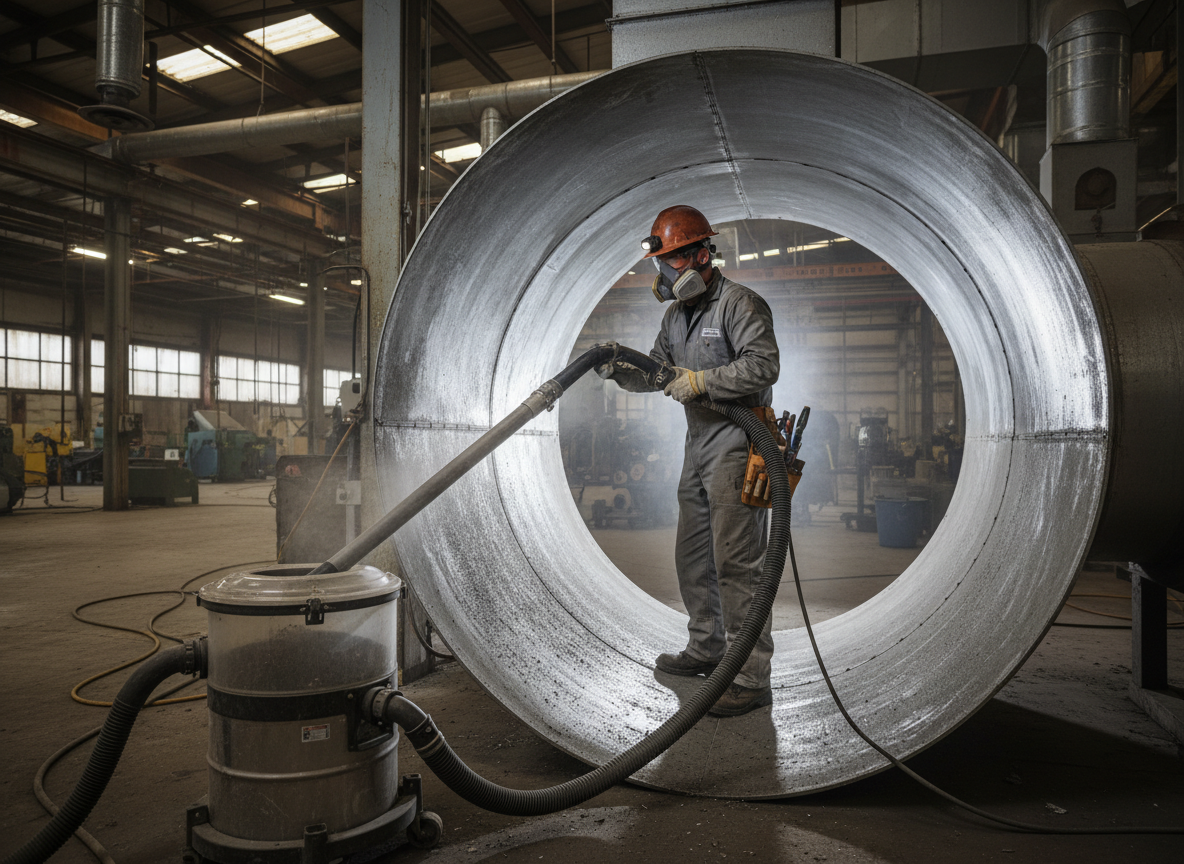
Industrial facilities in Benbrook often feature long runs of large-diameter galvanized ductwork installed decades ago in buildings near Benbrook Lake and along Highway 377. These systems collect fine silt, metal particles, and manufacturing residues that standard residential equipment cannot handle. Proper cleaning requires truck-mounted negative-air machines with HEPA filtration and sectional brushes sized for 12- to 36-inch ducts to prevent cross-contamination between production zones.
Hot Texas summers increase cooling demand and push more air through these systems, accelerating buildup in rooftop units common on industrial parks west of Benbrook. Access points are frequently limited by high ceilings and machinery layouts, so technicians must map the entire trunk and branch network before starting. Failure to isolate zones can spread contaminants into clean assembly areas, creating compliance issues for facilities that must meet indoor air quality standards.
Terrain around Benbrook includes gentle slopes that direct stormwater toward lower-lying industrial sites, occasionally introducing moisture into duct insulation. This combination of dust and occasional humidity promotes microbial growth inside lined sections. Crews address it by removing saturated insulation where needed and applying EPA-registered sanitizers only after mechanical cleaning is complete.
Technician insight
In Benbrook, the thing that catches most people out with Industrial air duct cleaning is how quickly fine silt from open land west of the lake packs into long horizontal runs in older warehouses, forcing extra time to break up the compacted layer before vacuuming can finish the job.
Manufacturing Plant Off Benbrook Blvd
A production facility near Benbrook Blvd reported uneven cooling and visible dust on equipment. Inspection showed heavy silt and metal fines lodged in the main supply trunks. Crews isolated the warehouse zones, ran sectional brushes through the 18-inch lines, and extracted the material with truck-mounted vacuums. Airflow returned to design levels and the plant resumed normal operations the same day.
How it works
- 1
Site Assessment
Walk the facility to map duct routes, identify access points, and note any production areas that must remain isolated during work.
- 2
Zone Isolation
Set up temporary barriers and negative-air machines to contain debris and maintain separation between cleaned and uncleaned sections.
- 3
Mechanical Cleaning
Use powered brushes and high-volume vacuum collection to remove dust, metal shavings, and residues from trunk lines and branches.
- 4
Post-Cleaning Verification
Inspect with cameras and test airflow to confirm the system meets the facility's operational requirements before restoring full service.
Pricing
Pricing varies by duct length, access difficulty, and contamination level; site assessment required before quote.