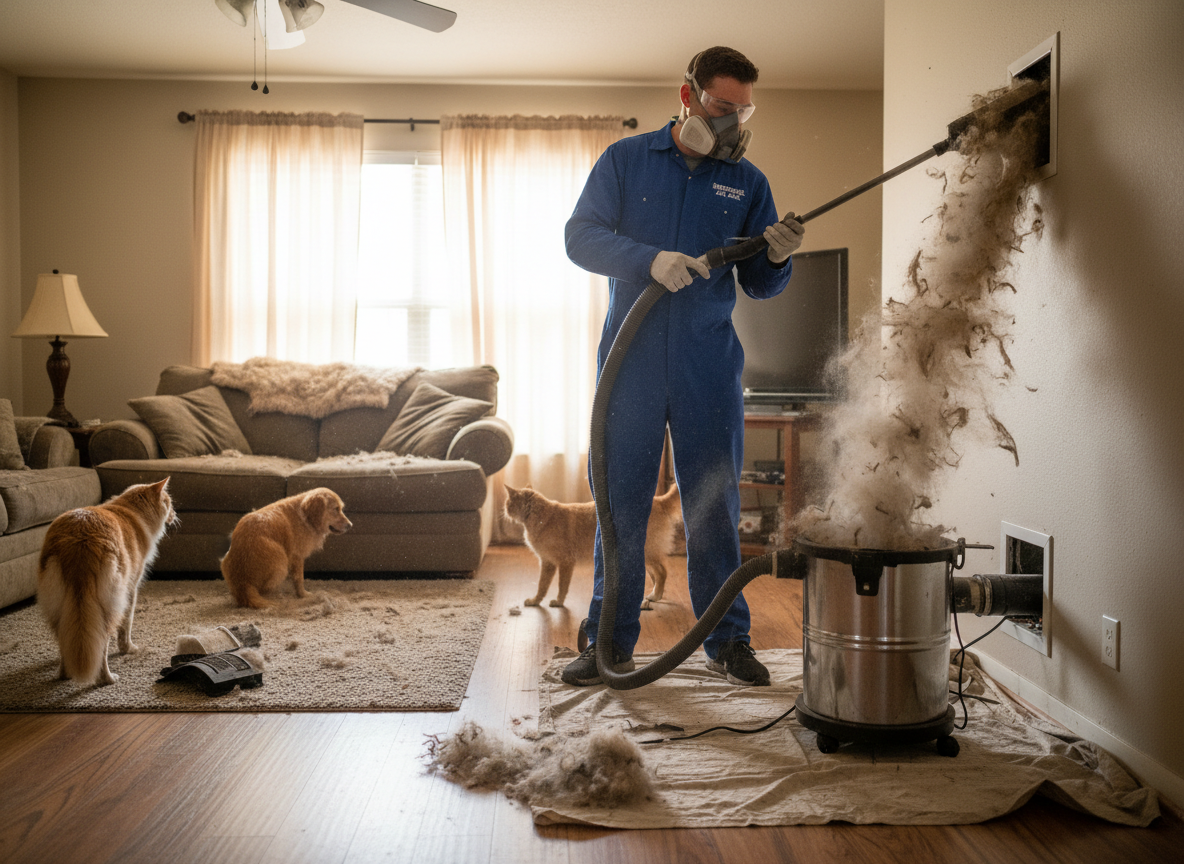
Benbrook homes, many built from the 1960s onward in Tarrant County, rely on central forced-air systems that run heavily from May through October. Pet hair and dander travel through supply and return lines and lodge in flex duct sections, elbows, and around evaporator coils. Standard vacuuming misses these spots because the material mats against the duct walls and mixes with Texas dust, creating a dense layer that restricts airflow and recirculates allergens.
Technicians use negative-air machines with HEPA filtration and rotary brushes sized for both rigid metal and flexible ducts common in Benbrook ranch-style houses. The process starts at the main trunk near the air handler on Benbrook Blvd properties, working outward to each register so hair does not get pushed deeper into wall cavities. Care is taken around older homes where duct tape seals have dried out; disturbing them can create new leaks that pull attic dust back into the system.
After brushing, compressed air and vacuum extraction clear the loosened material from every branch run. Technicians check for pet hair that has collected on coil fins and in the condensate pan area, where moisture can turn the debris into a breeding ground for mold. Final inspection includes airflow readings at multiple registers to confirm the system moves air evenly again.
Homeowners in neighborhoods near Benbrook Lake often notice the difference first during the first cool snap when the furnace kicks on and previously trapped hair begins to move again. Regular pet hair cleaning prevents the need for more invasive duct replacement later.
Technician insight
In Benbrook the thing that catches most people out with pet hair duct cleaning is the flex duct runs in 1970s and 1980s homes along the western side of town. Once hair mats inside the liner, standard shop-vac attachments just slide over it, so you have to use the right brush head or the restriction never clears.
Two-dog household near Benbrook Lake
Heavy shedding from two large dogs had reduced airflow at the master bedroom register. Inspection found thick mats inside the flex runs feeding the back bedrooms. After negative-air brushing and extraction, airflow readings returned to normal and the homeowner reported no more dust on surfaces within days.
How it works
- 1
System Assessment
Technician inspects every accessible register, the air handler, and trunk lines to locate heavy pet hair deposits and note any damaged flex sections.
- 2
Negative Air Setup
Equipment connects at the air handler to create continuous suction while brushing proceeds from the farthest registers inward.
- 3
Mechanical Agitation
Rotary brushes sized for each duct diameter break up matted hair without tearing the liner common in Benbrook homes.
- 4
Extraction and Coil Check
Vacuum extraction removes loosened material; coils and the condensate area are inspected and cleared of embedded dander.
- 5
Final Airflow Verification
Readings at multiple registers confirm restored flow before the system is returned to normal operation.
Pricing
Cost depends on number of runs, duct material, and access in single-story versus two-story Benbrook homes.